

// Recognizing, Assessing & Reducing Technical Debt Sustainably
Managing Technical Debt: Safeguarding IT Stability, Security & Efficiency
Technical debt arises when companies postpone modernization and continue to use outdated IT systems – leading to higher costs, increased risks, and reduced flexibility. With Raynet One, you can precisely identify and assess this debt and systematically reduce it before performance and security are compromised.
Minimise Technical Debt – for secure, stable and future-proof IT
Technical Debt arises when companies continue to use outdated or unsupported hardware and software. The result: productivity losses, security gaps and more difficult modernisation processes.
This Technical Debt in the IT infrastructure destabilises business processes, slows down innovation and negatively impacts the customer experience. It causes high maintenance costs, hinders scalability and creates hidden risks that can be costly for companies in the long term.
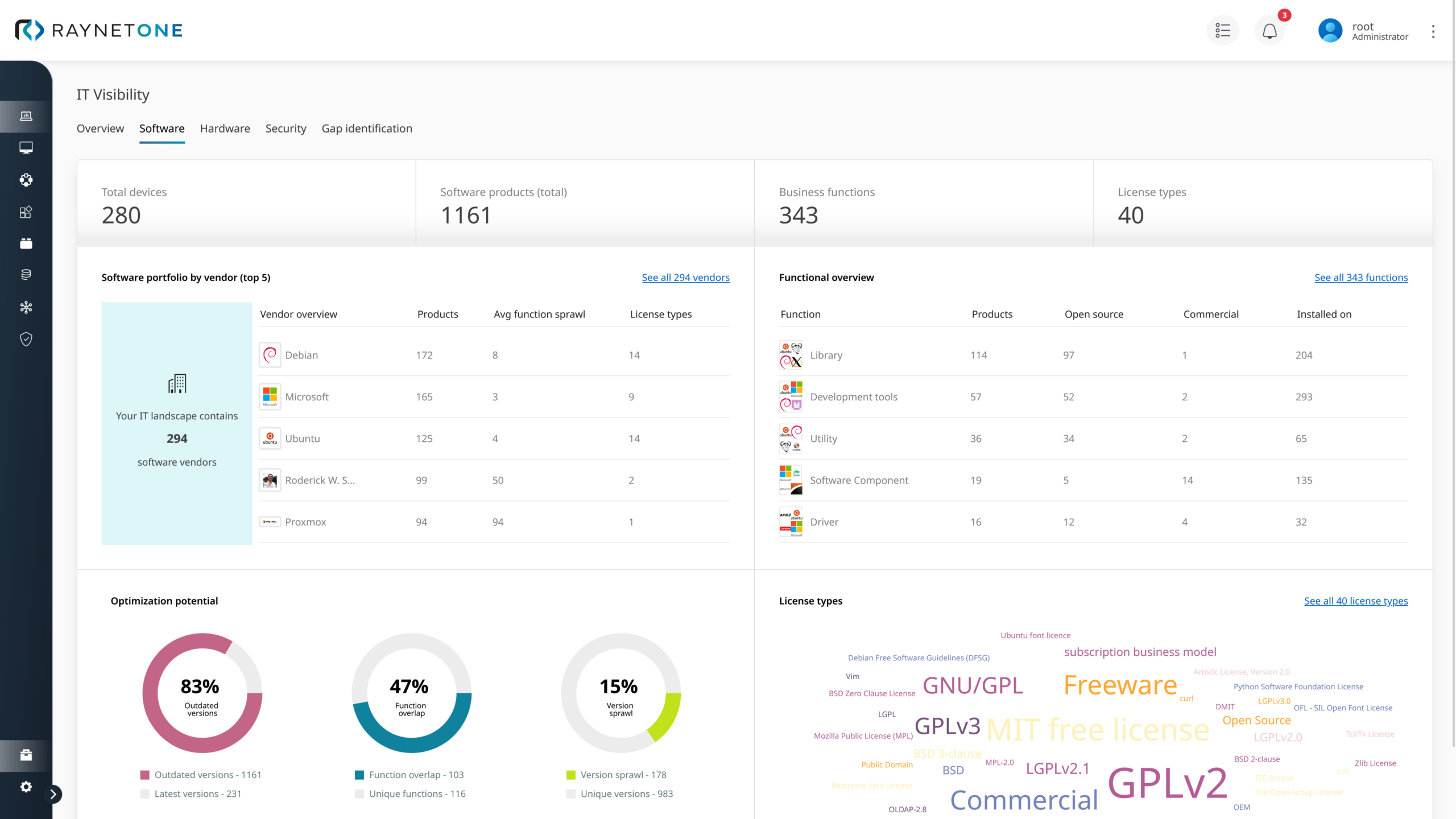
Raynet One gives you full transparency over your technical debt. The platform identifies all relevant assets, integrates vulnerability, EoL and EoS data, and accurately assesses risks. This allows you to prioritise debt, reduce it in a targeted manner and make your IT environment permanently stable, secure and future-proof.


Ensure that your IT remains debt-free and future-proof
See the whole liability
Unsupported, unpatched, redundant, and undocumented systems counted in one view, rather than in four separate reports.
Prioritize by cost, not age
Exposure, usage, and business criticality decide what gets fixed first, so budget lands on the debt that is actually expensive.
Prove the debt is shrinking
Measure repeatedly and show whether a quarter of modernization work moved the number, instead of asserting that it did.
Give the team its capacity back
Less debt means fewer disruptions, less firefighting, and more of the team's time spent on work that moves the business forward.
Identify, evaluate and reduce Technical Debt in IT with Raynet One
Raynet One provides valuable insights into your IT environment and helps you to precisely identify, evaluate and systematically reduce Technical Debt.
In IT, technical debt arises both consciously, when modernisation is postponed for budgetary or resource reasons, and unconsciously, for example through EoL/EoS systems, missing security patches or shadow IT. Typical examples include servers with expired support contracts, end devices with outdated operating systems such as Windows 7, legacy applications without security updates, or unpatched databases.
Unlike classic software problems, technical debt directly affects IT infrastructure, security, and business processes. With the integrated Raynet Technology Catalog, you receive continuously updated IT asset data with lifecycle information and EoL/EoS status – the basis for full transparency.
With Raynet One, you can not only identify Technical Debt, but also prioritise and automatically reduce it – before it becomes a risk to security and productivity.
How METRO identified Technical Debt and reduced IT costs with Raynet

In a comprehensive IT asset management project, METRO AG, together with Raynet and USU, achieved a key goal: complete transparency regarding Technical Debt across the entire IT infrastructure.
The combination of Raynet Unified Data Platform and USU License Management made obsolete assets and unused software visible – the basis for strategic optimisation of costs, security and efficiency.
This enabled METRO to modernise its hardware and software portfolio in a sustainable manner and make it future-proof.
Customers who rely on Raynet technologies




Technical Debt only gets funded once somebody can size it
Every IT team knows it is carrying debt. Far fewer can say how much, where it is concentrated, or whether last year’s modernization effort actually reduced it, which is exactly why those budgets are so hard to defend. Technical Debt is the one liability on the IT balance sheet that nobody puts a figure against. Raynet One measures it, because the inputs already sit in one record:
- Sized, not sensed: unsupported, outdated, and redundant components are counted against the normalized installed base, so the debt has a scope rather than a feeling: how many systems, running what, owned by whom.
- Weighted by real exposure: lifecycle status, known vulnerabilities, usage, and business criticality separate the debt that is expensive from the debt that is merely old, so remediation money goes where the liability actually sits.
- Tracked as a trend: the measurement repeats, so you can show whether debt grew or shrank over a quarter and prove a modernization program worked rather than asserting it.
- Made arguable: each item carries ownership, usage, and business context, so the case for replacement is made in risk and impact rather than in version numbers.
Every other discipline on this platform finds one kind of debt. This is the view that adds them up.
Further use cases, you might also be interested in
Frequently asked questions about Technical Debt
What is Technical Debt?
Technical Debt arises when short-term IT decisions lead to complexity, inefficiency or risks in the future. It often results from a lack of standards, inadequate documentation or the use of outdated systems.
What causes Technical Debt?
Technical Debt usually arises from time pressure, inadequate planning or quick workarounds. Common causes include outdated software, a lack of lifecycle management and undocumented systems.
What risks does Technical Debt pose for companies?
Uncontrolled technical debt increases IT costs, slows down projects and jeopardises security. Outdated or unsupported systems that pose compliance and security risks are particularly critical.
How can Technical Debt be identified?
Companies can identify Technical Debt through regular IT transparency analyses, inventorying and monitoring. Tools such as Raynet One provide a complete overview of all assets, their lifecycle and support status.
How can Technical Debt be reduced?
It can be reduced through modernisation, consolidation and lifecycle management of IT assets. With a clear strategy, costs can be reduced, risks minimised and innovation capabilities increased.
How does Raynet One support the management of Technical Debt?
Raynet One offers true IT asset visibility and integrates data from over 200 sources. This enables companies to identify outdated, redundant or insecure systems at an early stage and reduce technical debt in a targeted manner.
Contact our experts
Interested in our solutions, need further Information, or have questions?
With more than 25 years of experience and numerous customer projects worldwide, we can help you with your challenges – contact us today!