

// Hardware Asset Management
Keep hardware records true to what is actually deployed
Hardware Asset Management is the process of discovering physical IT assets, keeping their records accurate as those assets move and change, and managing them from deployment through to retirement. The goal is a hardware inventory you can plan and budget against, rather than one that has to be rebuilt every time somebody asks a question about it.
Hardware records drift, and nothing announces it
Hardware moves in ways software does not. A laptop is reassigned to a new starter, a server is relocated during a data center consolidation, a switch is swapped out mid-maintenance, a device leaves the building with somebody who left the company. None of those events announces itself to an inventory, and none of them is anybody’s job to record.
So the record and the reality separate quietly, and both directions cost money. Devices that were retired years ago stay on the books, inflating refresh budgets and support contracts. Devices that were never recorded stay invisible, which means they are also unpatched, unsupported, and outside every compliance report. Most organizations discover both at the same moment, during an audit, a refresh planning cycle, or an incident.
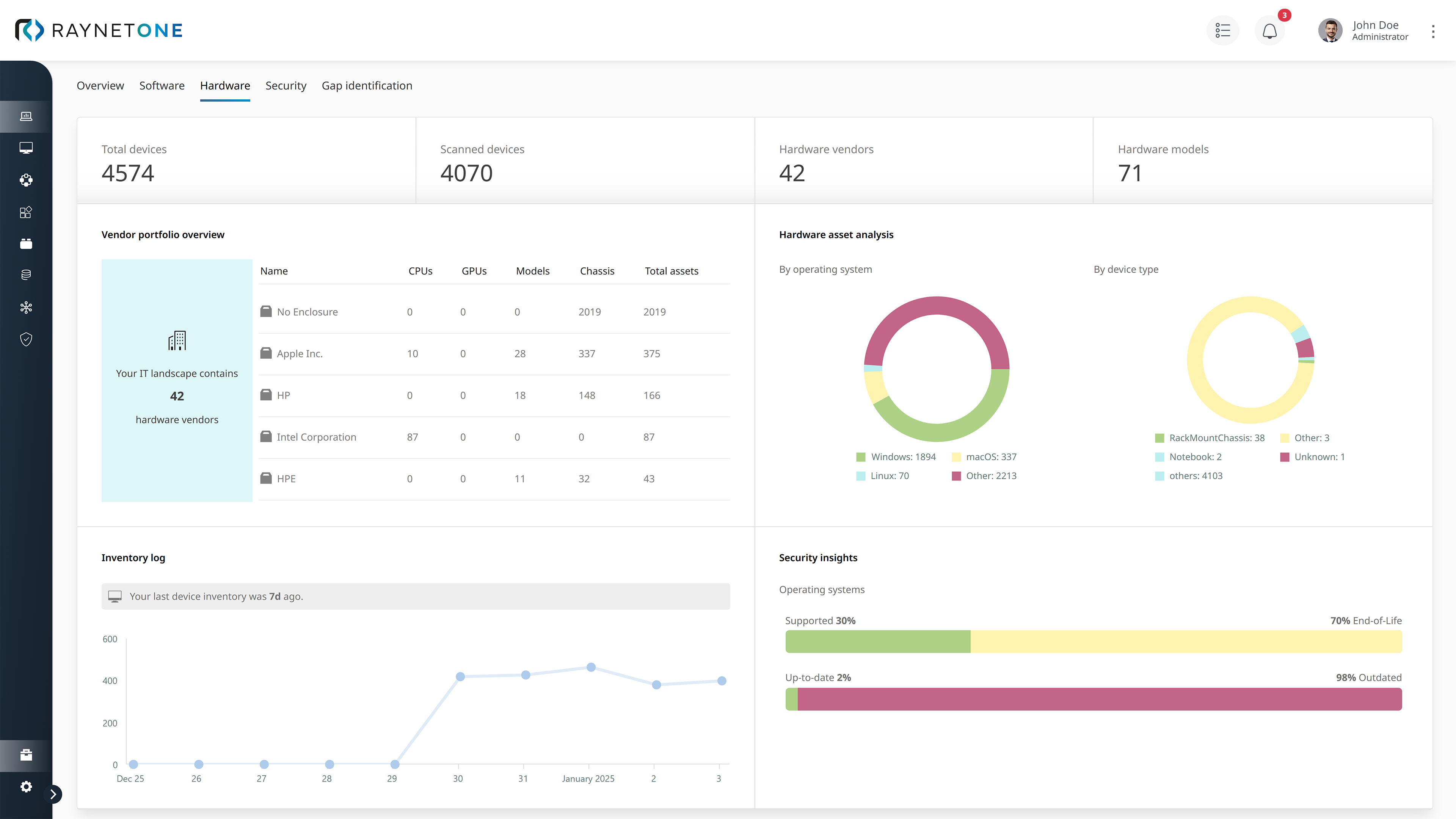
Raynet One keeps the picture current instead of rebuilding it. Physical assets are discovered continuously across distributed environments, records from different sources are reconciled into one entry per device, and each entry is enriched with manufacturer, model, classification, and support information from the Raynet One Technology Catalog.
The result is a hardware inventory that stays close enough to reality to plan against: refresh cycles costed before the deadline, audits answered from existing records, and unsupported devices visible while there is still time to act.
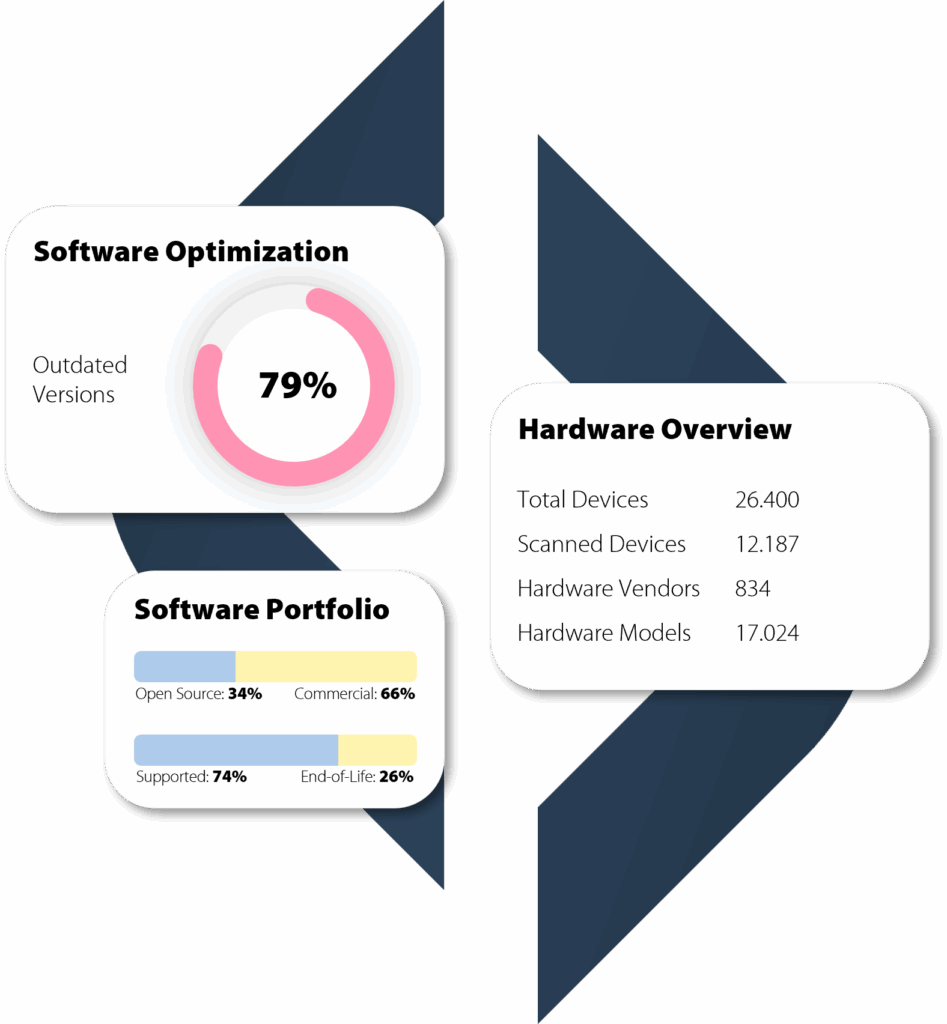

Plan hardware on data that reflects the estate
See the devices no agent reaches
Discover network equipment, printers, IoT devices, and unmanaged hardware alongside agent-managed endpoints.
Resolve duplicates into one record
Consolidate data from multiple sources into one accurate device record with consistent hardware details.
Plan refresh before it becomes urgent
Track hardware lifecycle and support status to plan replacements and budgets proactively.
Answer audits from data you already hold
Keep ownership, location, and asset status records current for audits and security reviews.
Hardware Asset Management
Raynet One discovers physical IT assets through agent-based inventory where an agent can run, and through agentless methods including network scanning and SNMP where one cannot. That second path is what brings network equipment, printers, IoT devices, and other unmanaged hardware into the same inventory as laptops and servers.
Records arriving from those sources, and from the management systems already connected to your environment, are correlated against each other. Integrated ETL technology standardizes and matches them so a single physical device resolves to a single entry, and so duplicate records, incomplete attributes, and unmanaged devices surface as findings rather than as noise somebody has to sort through manually.
The Raynet One Technology Catalog then enriches each entry with manufacturer, model, product family, classification, and support information. This is what turns a discovered device into something you can make a decision about: whether the model is still supported, what it is used for, who owns it, and where it sits in its lifecycle.
From there the same data serves several processes at once. Refresh planning works from support status and model, security reviews work from what is deployed and unsupported, procurement works from what is genuinely in use, and audits work from records that were maintained as the estate changed rather than assembled afterwards.
Successful IT Asset Management: METRO AG Achieves Full Transparency with Raynet One

In a global IT Asset Management (ITAM) project, METRO AG successfully relied on the Raynet Unified Data Platform and USU License Management. The result: complete transparency over its complex, decentralized IT infrastructure.
Thanks to the centralized data foundation, METRO AG was able to sustainably optimize its entire hardware and software portfolio, ensure compliance, and reduce IT costs in the long term – a milestone for efficient and future-proof Hardware Asset Management.
Customers who rely on Raynet technologies




One device, one record, however it was discovered
Software mostly announces itself. Hardware does not. The same laptop reports one model string through its BIOS, another through SNMP, another through a vendor API, and another again through whichever management tool claimed it first. Manufacturer names fragment across Hewlett-Packard, HP, and HP Inc. Model strings carry SKU suffixes and regional variants that read as different products entirely. Most tools store all of it and call the result an asset register. Raynet One resolves it:
- Canonical manufacturer and model: every discovered device resolves to one record in the Raynet One Technology Catalog, so a fleet of identical machines reports as one model rather than forty spellings of it.
- Sources reconciled, not stacked: entries arriving from inventory, network scans, and connected management systems are matched to the same physical device instead of accumulating as near-duplicates.
- Hardware and firmware kept distinct: the device and the operating system or firmware running on it are modeled as separate layers, so support status, advisories, and refresh decisions land on the right one.
- Lifecycle maintained per model: support and availability information is curated manufacturer by manufacturer, because hardware has no central equivalent of the NVD and every vendor publishes its lifecycle data differently.
Counting devices is the easy part. Knowing that two records are the same machine, and that forty are the same model, is what makes the count worth budgeting against.
Further use cases, you might also be interested in
Frequently asked questions about Hardware Asset Management
What is Hardware Asset Management?
Hardware Asset Management is the discovery, management, and optimization of physical IT assets across their lifecycle, from procurement and deployment through usage and maintenance to decommissioning. The aim is accurate, current records that support planning, security, compliance, and cost decisions.
How does Hardware Asset Management relate to Software Asset Management and IT Asset Management?
What makes Hardware Asset Management with Raynet One different?
How does Raynet One discover hardware that cannot run an agent?
How does Hardware Asset Management reduce cost?
In three places, usually. Retired devices still carried on the books inflate support contracts and refresh budgets. Devices bought because nobody could confirm what was already available duplicate spend. And unplanned replacement after a failure costs more than a scheduled one. Accurate records address all three, and lifecycle data turns refresh from a reaction into a plan.
How does Hardware Asset Management relate to End-of-Life & End-of-Support Management?
Contact our experts
Interested in our solutions, need further Information, or have questions?
With more than 25 years of experience and numerous customer projects worldwide, we can help you with your challenges – contact us today!