
// IT Asset Discovery & Inventory
Find the assets a network scan will never reach
IT Asset Discovery & Inventory is the process of finding every asset in your environment, recording what it is, and keeping that record current as things change. The goal is one inventory covering hardware, software, cloud workloads, SaaS applications, and IoT alike, rather than several partial ones that disagree with each other.
(Zylo, 2026 SaaS Management Index)
Discovery was built for a network you owned
Classic discovery assumes a perimeter. Scan the subnet, install an agent, read Active Directory. That approach worked well when everything an organization ran sat on hardware it owned, inside a building it controlled.
Few estates look like that now. Workloads run in cloud tenants where there is no subnet of yours to scan. SaaS applications cannot host an agent and will never appear on a network sweep. Remote devices connect from home networks and may go months without touching a corporate segment. Against that estate, an inventory built on scanning alone is not slightly incomplete. It is structurally blind to whole categories of asset, and it cannot tell you which ones.
Raynet One combines the methods instead of choosing one. Agent-based inventory runs where an agent can be installed, agentless and network-based discovery covers what cannot take one, and provider APIs reach cloud and SaaS. All three land in the same record set rather than in three tools that each hold part of the answer.
The result is a Single Source of Truth for the whole estate: unmanaged systems surfaced, shadow IT visible, cloud and SaaS counted alongside physical assets, and one record set the rest of your processes can draw from.
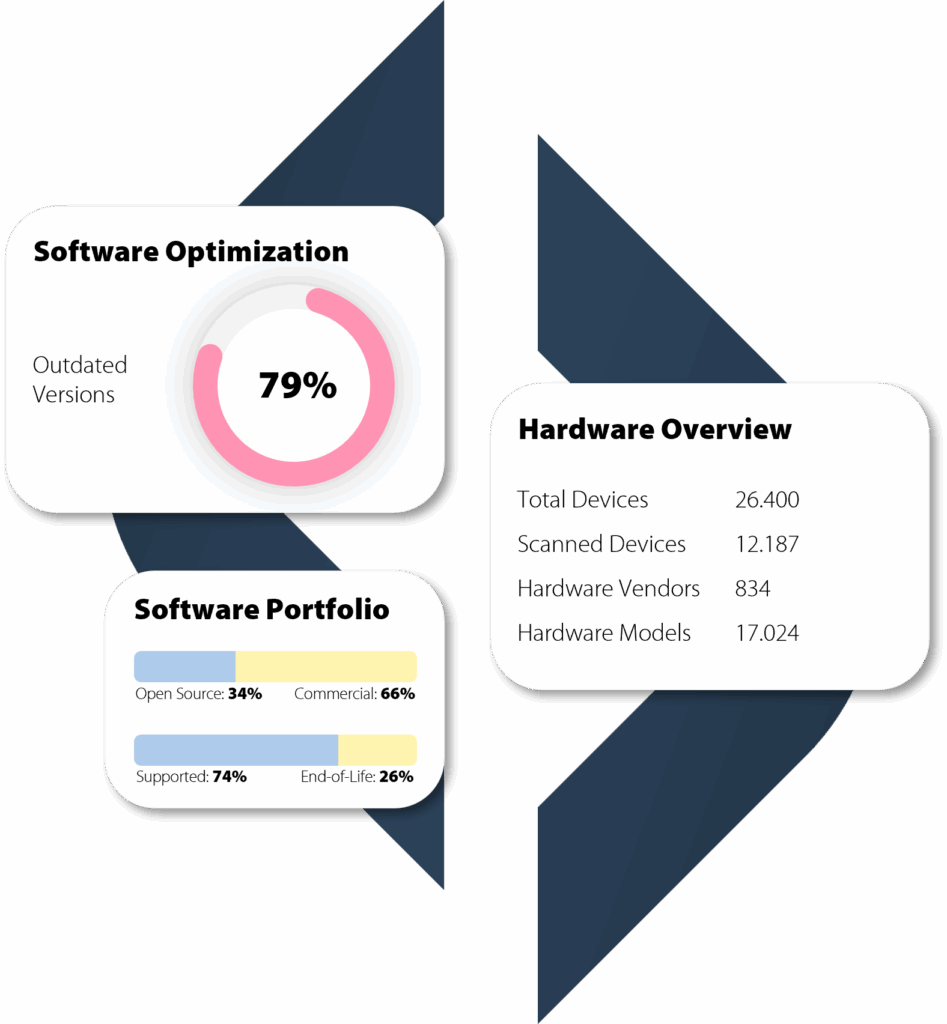

One inventory instead of several partial ones
Start without deploying anything
Start with agentless scanning and Active Directory, add connectors, and deploy agents only when needed.
Reach past the perimeter
Discover cloud workloads, SaaS applications, and remote devices through provider APIs beyond traditional network scans.
Eliminate blind spots
Identify unmanaged assets, orphaned systems, and shadow IT to close visibility gaps and reduce risk.
Create a Single Source of Truth
Unify asset data and share reliable inventory records across ITSM, CMDB, and security tools.
IT Asset Discovery & Inventory with Raynet One
Raynet One covers discovery through several methods because no single one reaches everything. Agent-based inventory gives depth on managed endpoints. Remote and agentless scanning covers systems that cannot take an agent, including network equipment and IoT. Portable and zero-touch options handle isolated or air-gapped environments. Connectors reach cloud and SaaS through provider APIs.
Most organizations start at the light end. A network scan and an Active Directory integration produce a usable picture within minutes, connectors extend it to the cloud and SaaS estate, and agents come later where deeper data justifies them. Nothing has to be deployed before the inventory is worth looking at.
What arrives from those sources is then reconciled. Integrated ETL technology correlates and standardizes records so one physical or logical asset resolves to one entry, and the Raynet One Technology Catalog enriches each entry with manufacturer, product, version, classification, and lifecycle information. This is the step that turns raw discovery output into an inventory people will trust.
Discovery then runs continuously rather than as a project. New assets appear, retired ones are flagged, and changes are picked up as they happen, so the inventory stays close to the environment instead of describing the day it was built.
Every discovery tool covers the estate it can reach, so the question worth asking is what happens at the edge of your network, because that is where a growing share of the estate now lives. There is no subnet to scan inside a cloud tenant. No SaaS application will host an agent. The only route in is the provider’s own API, which means an inventory is only as wide as the connector list behind it.
Raynet One ships more than 200:
- Cloud and SaaS reached natively: Microsoft 365, Azure, AWS, ServiceNow, Zoom, Dropbox and more than 200 others connected through their own APIs, so those assets are discovered rather than estimated.
- SaaS, PaaS, and IaaS alike: infrastructure, platform, and application layers each have their own discovery path, so a cloud workload and the SaaS tool running beside it both land in one inventory.
- Push as well as pull: connectors move data in both directions, so the inventory feeds ITSM, CMDB, and security tooling instead of becoming one more system somebody has to check separately.
- No agent required to begin: connectors and agentless scanning produce a usable inventory before any deployment decision is made, which is how most organizations start.
A discovery tool is worth what it can reach. The connector list is not a feature comparison detail here, it is the part that decides how much of your estate the answer actually covers.
From SAM to IT Visibility: How a global corporation made transparency a priority

A leading global sporting goods manufacturer relied on Raynet One‘s powerful technologies to modernize its Software Asset Management (SAM) and achieve complete transparency across its entire IT infrastructure.
The project established the so-called “Big Picture”, which gave all stakeholders a clear, consolidated view of hardware and software assets. This transparency led to IT visibility being established as a governance priority at board level for the first time – a decisive step for sustainable IT strategy and compliance.
“Thanks to Raynet, we have not only gained transparency, but also laid the foundation for making strategic decisions quickly and based on data.”– Head of IT, leading sporting goods manufacturer
Customers who rely on Raynet technologies



Discover more about IT Asset Discovery & Inventory
Frequently asked questions about IT Asset Discovery and Inventory
What is IT Asset Discovery & Inventory?
How is it different from True IT Asset Visibility?
Discovery and inventory is the mechanism: finding assets and recording them. True IT Asset Visibility is the outcome: a complete, normalized, enriched picture that teams can actually make decisions from. Discovery gets the data in. Normalization, enrichment, and reconciliation are what make it trustworthy enough to act on.
What makes IT Asset Discovery & Inventory with Raynet One different?
Reach, and the fact that it does not depend on one method. Agent-based inventory, agentless and network scanning, portable and zero-touch options, and more than 200 SaaS and cloud connectors all feed one record set. That matters most at the network edge, where cloud tenants and SaaS applications cannot be scanned at all and the provider API is the only way to see them.
Do we need to install agents everywhere to get started?
Which systems can Raynet One discover assets from?
How does IT Asset Discovery & Inventory relate to Cyber Asset Attack Surface Management?
Discovery and inventory establishes what exists. CAASM takes that inventory and adds the security perspective: where control coverage is missing, which assets are exposed, and how findings route to owners. One is the foundation, the other is what a security team builds on top of it.
Contact our experts
Interested in our solutions, need further Information, or have questions?
With more than 25 years of experience and numerous customer projects worldwide, we can help you with your challenges – contact us today!